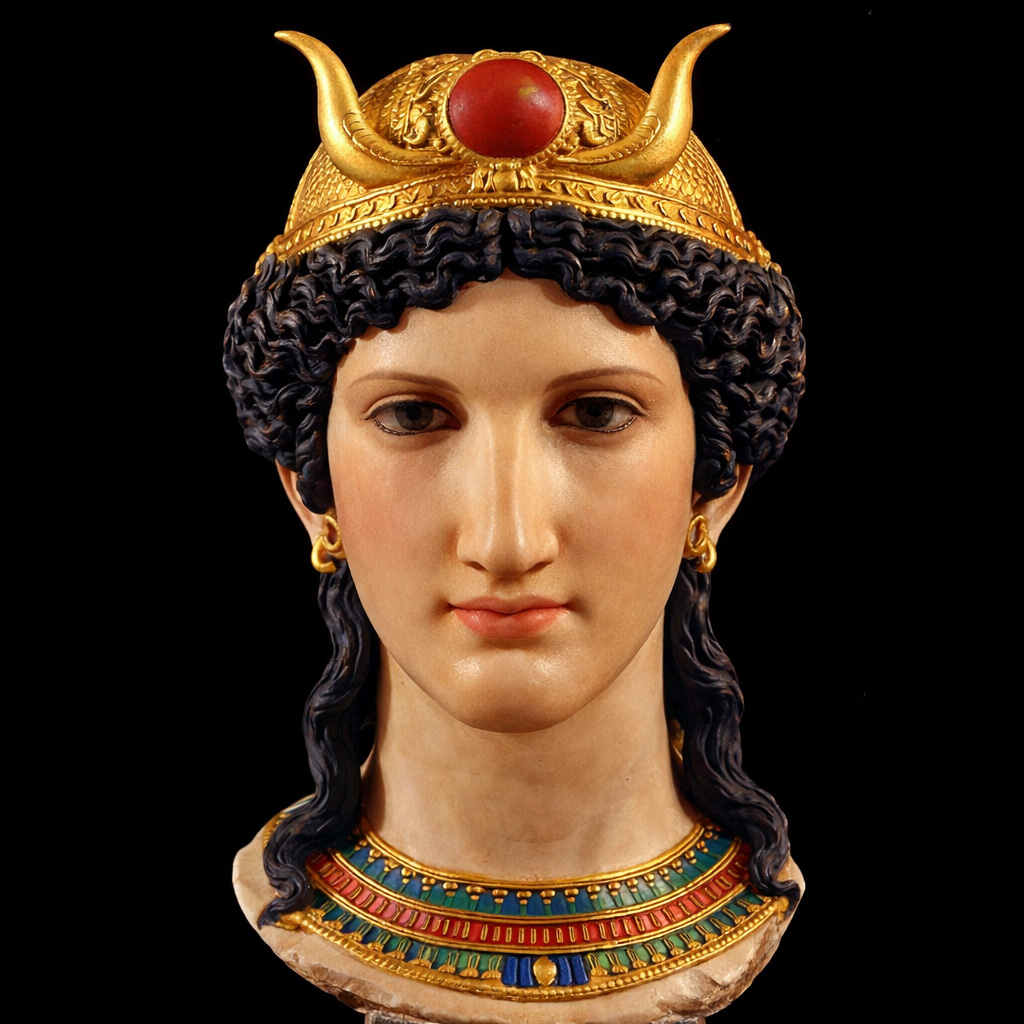
This experience does not reconstruct the Isis bust. It does not claim that specific pigments, gemstones, eye colours, crowns, or skin finishes belonged to this object. Where object-specific evidence is missing, the focus shifts to uncertainty and to how interpretation, perception, and imagination operate when knowledge is incomplete. Where comparative archaeological evidence exists (for example, from related Isis contexts), it informs a range of historical possibilities but is not treated as object-specific proof.
This app is an engagement experience about the limits of evidence. It uses a staged digital process to show how images can become persuasive—even when the underlying knowledge is partial. The goal is to make visitors ask: “What would we need to know to claim this?”
The sequence follows a Pixel → Palette → Morph progression. The image breaks into pixels, becomes a reduced palette, and then reassembles into an interpretive visual prompt. This prompt is not presented as a “before/after” restoration. It is a tool for thinking about what can be responsibly claimed and what must remain open.
The “colour prompt” midpoint shows a contextual range inspired by broadly attested Egyptian and Roman pigment traditions. It should be read as a discussion aid (what was possible in a period), not as proof of what was used on this specific statue.
The later frames are interpretive prompts. They expose the boundary between evidence and imagination and should not be read as a validated reconstruction of this artifact.
Because no object-specific pigment traces are presented here, the experience avoids making claims about features such as crowns, gemstones, eye colours, or specific jewellery types. While comparisons with other artifacts can indicate what may have been possible in a wider historical context, they do not constitute proof for this specific statue. The visual material is therefore presented as interpretive, and it is framed explicitly as interpretation throughout.
If you want to explore these ideas further—and test your intuition about evidence and uncertainty—take the quiz and see how you score.
This short quiz invites you to think about what we know — and what we don’t.
It explores how we decide what counts as evidence, what remains uncertain,
and what we can still do when information is incomplete — or even absent.
Choose the answers that feel most convincing to you.
Then press Finish.
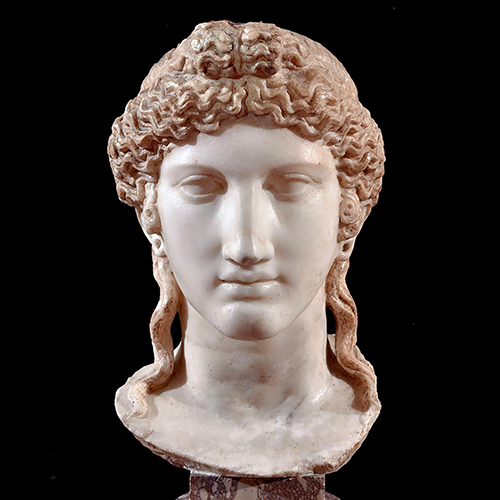
1. Can we confidently reconstruct the original colours of this bust?
2. When evidence is missing, what is the most responsible approach?
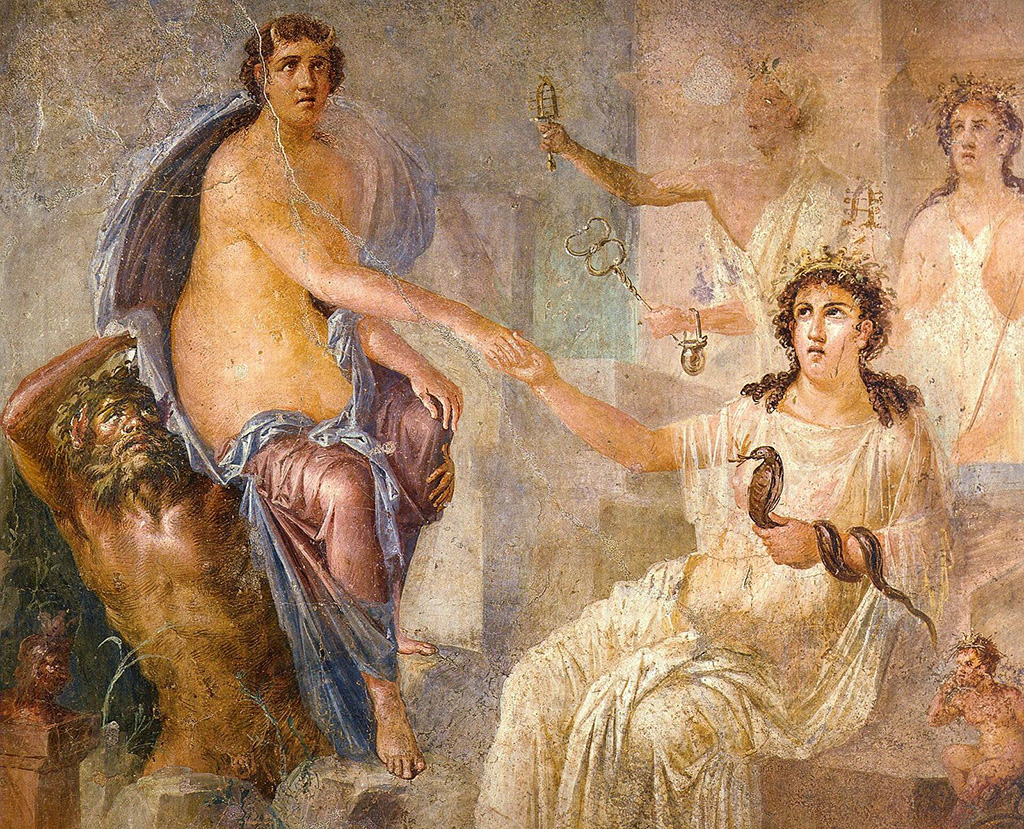
3. What does a coloured image usually suggest to viewers?
4. What can we still do without knowing the original colours?